
Most developers today are familiar with the basic Retrieval-Augmented Generation (RAG) pattern. You take some documents, chunk them, turn them into vectors, and then search through them to give an LLM some context. It sounds simple enough when you’re running a script on your laptop, but things get complicated quickly when you move to production. You have to worry about what happens when an embedding service goes down halfway through a thousand-document sync, or how to handle long-running background tasks without managing complex job queues.
In this project, I decided to tackle these problems using Golem, a platform for durable execution. Instead of building a monolithic server or a collection of microservices, I built a set of autonomous agents that each handle a specific part of the RAG pipeline.
The Agentic Approach
The core idea behind Golem is that your code can be durable. When you deploy an agent, it isn’t just a running process that vanishes if the server restarts. Its state is persistent, and its execution can be paused and resumed seamlessly. This changes how you think about architecture.
The Architecture
To understand how this all fits together, it’s helpful to look at the overall architecture. The system is designed to be decoupled, with each agent focusing on a single responsibility. This allows the system to remain resilient even when individual components or external services experience issues.
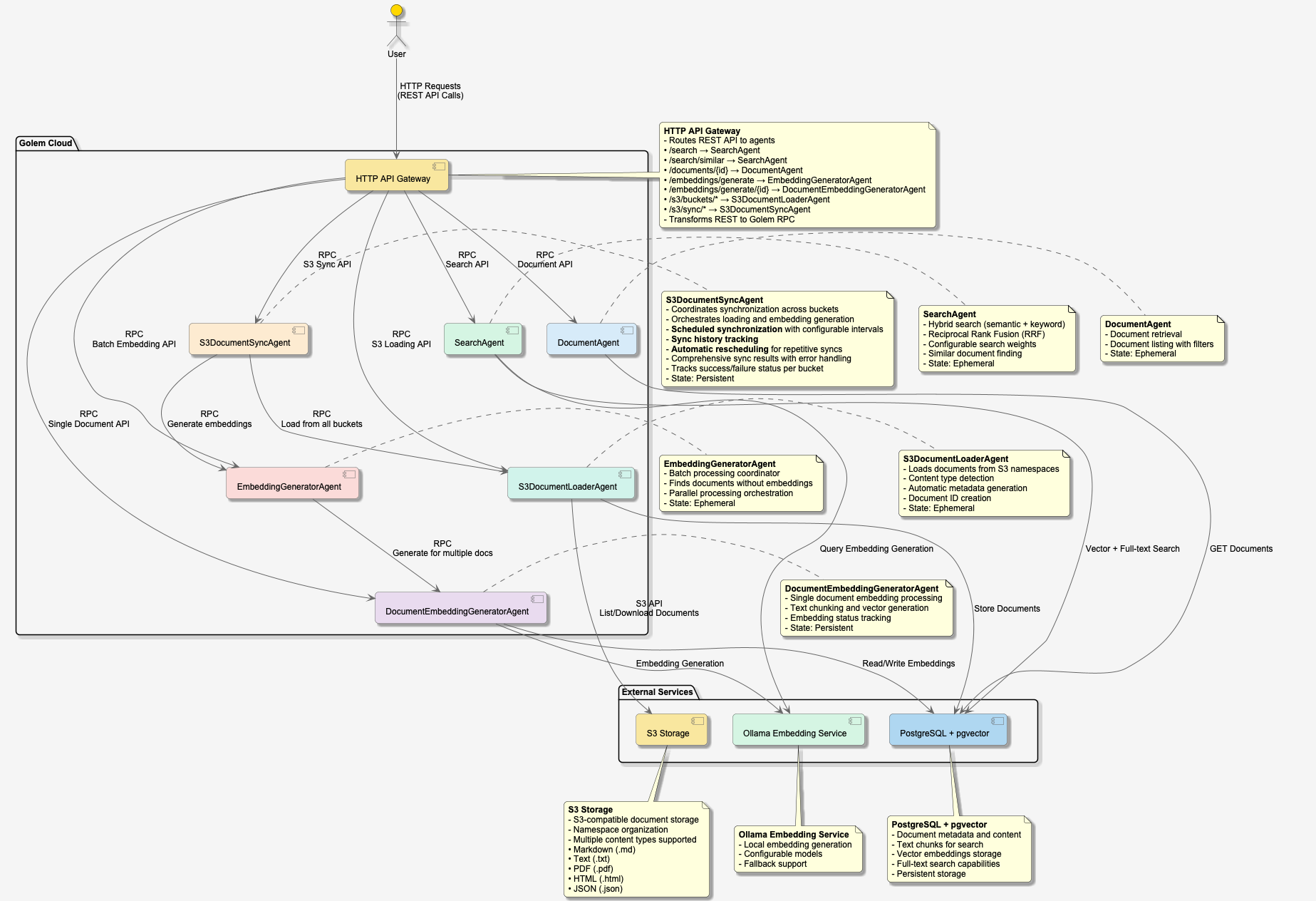
At the center of this ecosystem are several key agents:
- SearchAgent: Handles hybrid semantic and keyword search requests.
- DocumentAgent: Handles document retrieval operations.
- S3DocumentSyncAgent: Orchestrates the synchronization process and scheduling.
- S3DocumentLoaderAgent: Interfaces with S3 to list and fetch files.
- EmbeddingGeneratorAgent: Communicates with external providers to turn text into vectors.
- DocumentEmbeddingGeneratorAgent: Specialized worker for managing the chunking and embedding flow of individual documents.
How Agents Collaborate
One of the most powerful features of Golem is how these agents work together. Instead of one giant service trying to do everything, the system is a small society of specialized workers.
The synchronization flow is a perfect example of this collaboration:
- The S3DocumentSyncAgent acts as the orchestrator. When it’s time to sync, it asks the S3DocumentLoaderAgent for a list of buckets.
- For each bucket, the Sync agent triggers a parallel process. It doesn’t do the work itself; instead, it delegates by spawning Phantom Agents (ephemeral, isolated instances) of the S3DocumentLoaderAgent and EmbeddingGeneratorAgent to process each bucket independently.
- These phantom S3DocumentLoaderAgent instances pull document contents from S3 and store them directly in the database.
- Once the documents are ready, the EmbeddingGeneratorAgent (which is ephemeral and acts purely as an orchestrator) takes over. To handle high volume, it spins up multiple durable DocumentEmbeddingGeneratorAgent instances—one for each document ID.
This delegation relies on Golem’s natural agent instantiation. Because each
DocumentEmbeddingGeneratorAgentis uniquely identified by its document ID and has its own isolated state, we can process hundreds of documents in parallel without blocking the main sync process.
These agents interact with a few critical external services to keep the data flowing. We use PostgreSQL with the pgvector extension to store both the structured metadata and the high-dimensional embeddings. The source documents themselves live in S3 Storage, which acts as our primary document store. Finally, we rely on an Embedding API (such as OpenAI) to handle the heavy mathematical lifting of vector generation.
Out-of-the-Box Features: Endpoints, Config, and Secrets
One of the biggest hurdles in microservice development is the “glue code”—handling HTTP routing, parsing configuration files, and managing secrets. Golem handles this out of the box with a few simple annotations:
- HTTP Endpoints: You don’t need a separate web framework like Axum or Actix. By adding
#[endpoint]annotations to your agent traits, Golem automatically exposes them as REST APIs. Themountattribute at the trait level defines the base path, making your agents reachable by any HTTP client. - Typed Configuration: Agents can receive structured configuration via
#[agent_config]. You define a standard Rust struct with theConfigSchemaderive, and Golem ensures the values are correctly injected and validated at runtime. - Secure Secrets: For sensitive data like OpenAI API keys or database passwords, Golem provides a dedicated
Secret<T>type. These are marked with#[config_schema(secret)], ensuring they are handled securely, kept out of persistent logs, and never checked into source control. You manage them through the CLI or environment-specific secret stores.
Document Embedding
The DocumentEmbeddingGeneratorAgent is a durable agent that processes a single document identified by its ID.
#[agent_definition(mount = "/embeddings/{document_id}", durable)]
pub trait DocumentEmbeddingGeneratorAgent {
    fn new(document_id: String, #[agent_config] config: Config<EmbeddingAgentConfig>) -> Self;

    #[endpoint(post = "/generate")]
    async fn generate_embeddings_for_document(&self) -> AgentResult<u32>;

    #[endpoint(delete = "/")]
    async fn remove_embeddings_for_document(&self) -> AgentResult<()>;

    #[endpoint(get = "/status")]
    async fn get_embedding_status(&self) -> AgentResult<EmbeddingStatus>;
}
Generating embeddings for a document is a multi-step process. It first retrieves the document from the database, splits it into smaller chunks based on the chunk size and overlap defined in ChunkConfig, and generates vector embeddings for each chunk using the configured embedding service. The resulting embeddings are stored in the PostgreSQL pgvector table and linked to the original document ID.
Hybrid Search: The Best of Both Worlds
While semantic search is incredibly powerful for capturing the “meaning” of a query, it can sometimes struggle with specific keywords, product IDs, or technical terms that don’t have a clear semantic neighbor. To solve this, the SearchAgent implements a hybrid search strategy.
One of the most interesting parts is how easy it is to define these agents in Rust. Here is a look at the trait definition for the SearchAgent:
#[derive(ConfigSchema)]
pub struct SearchAgentConfig {
    #[config_schema(nested)]
    pub embedding: EmbeddingConfig,
    #[config_schema(nested)]
    pub db: PostgresDbConfig,
}

#[agent_definition(mount = "/search", ephemeral)]
pub trait SearchAgent {
    fn new(#[agent_config] config: Config<SearchAgentConfig>) -> Self;

    #[endpoint(post = "/similar")]
    async fn find_similar_documents(
        &self,
        document_id: String,
        limit: Option<u64>,
    ) -> AgentResult<Vec<SearchResult>>;

    #[endpoint(post = "/")]
    async fn search(
        &self,
        query: String,
        filters: Option<SearchFilters>,
        limit: Option<u64>,
        threshold: Option<f32>,
        config: Option<HybridSearchConfig>,
    ) -> AgentResult<Vec<HybridSearchResult>>;
}
The SearchAgent is marked as ephemeral because it doesn’t need to hold onto state between calls—it just performs the search and returns the results. This is ideal for request-response patterns where each interaction is independent.
It performs two parallel operations:
- Vector Similarity Search: Using
pgvectorto find the most semantically relevant chunks. - Keyword Search: Using PostgreSQL’s full-text search (
tsvector) to find exact matches for specific terms.
To combine these different scoring systems, I used Reciprocal Rank Fusion (RRF). RRF is a simple yet effective algorithm that ranks documents based on their position in the individual search result lists, rather than their raw scores. This prevents one search method from “overpowering” the other just because its scoring scale is different.
fn fuse_results(
    &self,
    semantic_results: Vec<SearchResult>,
    keyword_results: Vec<SearchResult>,
    config: &HybridSearchConfig,
) -> AgentResult<Vec<HybridSearchResult>> {
    // Helper for RRF score
    fn rrf_score(config: &HybridSearchConfig, rank: usize) -> f32 {
        1.0 / (config.rrf_k + (rank + 1) as f32)
    }

    let mut fused_results = HashMap::new();

    // Semantic RRF scoring
    for (rank, result) in semantic_results.iter().enumerate() {
        let score = rrf_score(config, rank);
        // ... insert into map with weight
    }

    // Keyword RRF scoring
    for (rank, result) in keyword_results.iter().enumerate() {
        let score = rrf_score(config, rank);
        // ... update or insert into map
    }

    // Convert to sorted vector
    let mut results: Vec<HybridSearchResult> = fused_results.into_values().collect();

    // Sort by combined score
    results.sort_by(|a, b| b.combined_score.total_cmp(&a.combined_score));
    Ok(results)
}
By fanning out these requests and fusing them in the agent, we get the precision of keyword search and the flexibility of semantic search in a single API call.
Handling Long-Running Tasks
The S3DocumentSyncAgent is where the durability of Golem really shines. Its job is to watch S3 buckets and ensure that every document is processed and embedded. In a traditional system, you would need a task queue like Redis or RabbitMQ to track progress and handle retries. With Golem, the agent itself tracks its history and state.
If the sync process is interrupted, Golem ensures it picks up right where it left off. I also implemented a self-scheduling mechanism so the agent can run periodically without any external cron jobs.
async fn execute_scheduled_sync(&mut self) -> AgentResult<bool> {
    log::info!("Executing scheduled sync");
    let _ = self.sync_all().await?;

    self.state.update_next_execution();

    if let Some(updated_schedule) = &self.state.sync_schedule
        && updated_schedule.is_repetitive
    {
        let schedule_time = get_next_execution_time(updated_schedule.interval_minutes);
        S3DocumentSyncAgentClient::get().schedule_execute_scheduled_sync(schedule_time);
        Ok(true)
    } else {
        self.state.delete_schedule();
        Ok(false)
    }
}
This snippet shows how the agent schedules its own next execution. Because the agent is durable, you don’t have to worry about losing the “next run” timer if the infrastructure moves or restarts.
Parallelism and Scale
This architecture naturally leads to a distributed processing philosophy. Instead of a single worker processing a queue of documents, we leverage Golem’s ability to fan out work to dedicated agent instances for each task.
Even though each agent execution is single-threaded to keep state management simple, the system scales by fanning out work to individual worker agents. We achieve massive parallelism while each piece of code remains dead simple—no locks, no mutexes, and no complex concurrency primitives. We just let Golem handle the distribution and durability.
Summary & Source Code
Building RAG this way feels different. You aren’t just writing functions that talk to a database; you’re designing a small ecosystem of workers that are guaranteed to finish their jobs. It removes a huge layer of boilerplate related to reliability and state recovery, letting you focus on the actual logic of retrieval and generation.
The complete codebase, infrastructure setup instructions (including PostgreSQL with pgvector and Docker Compose), and deployment configuration are available in the golem-rag-rust GitHub repository.